
The definition of “social selling” is being rewritten. For years, it meant posting content and hoping for the best. As we move into 2026, the data shows that the most successful sales professionals aren’t just “active” on social media—they’re methodical, data-driven, and integrated with their CRM and outreach workflows.
Our latest report, “The State of Sales on LinkedIn for 2026,” analyzed millions of data points to separate what works from what doesn’t. While the buzzwords focus on short-form video and AI agents, the real story in B2B sales is about precision.
Here are four social selling trends for 2026 and how to apply them in your outbound sales workflow with PhantomBuster.
Quick look: The data-driven evolution
| Trend | The old way (2024-2025) | The new way (2026) |
|---|---|---|
| Outreach volume | High volume (spray & pray) | Low volume (<25/week) with manual relevance checks |
| AI strategy | Generic content generation | Deep research & personalized drafting |
| Data hygiene | Manual CRM entry | Scheduled CRM sync (hourly or daily) |
| Engagement | Cold pitching immediately | Warming up leads before connection |
1. Why should you cut volume and focus on quality in 2026?
Our data shows a clear shift away from volume toward relevance. One of the most striking findings in our report is that sales reps who send fewer than 25 connection requests per week are twice as likely to achieve higher acceptance rates than those sending massive volumes.
This trend signals a shift away from fears about algorithm changes and toward a focus on relevance. Social platforms are getting better at detecting spam, but more importantly, buyers are getting better at ignoring it.
The reason is simple: quality compounds. When you focus on a smaller list of highly relevant prospects, you have time to research each one, craft personalized messages, and follow up thoughtfully. This approach respects both platform limits and your prospect’s attention.
How to automate for precision, not volume
You don’t need to blast 100 people a day. You need to find the right 20 people and treat them like VIPs.
The strategy: Use PhantomBuster’s Sales Navigator Search Export automation to build a curated shortlist instead of a bulk list.
The workflow:
- Run the Sales Navigator Search Export automation as step one in your PhantomBuster workflow.
- Extract a highly specific search (e.g., “CTOs in FinTech” who posted in the last 30 days).
- Manually review the CSV to remove anyone who isn’t a perfect fit. Alternatively, use PhantomBuster’s AI enrichment inside your export workflow to flag ICP-fit leads, then sanity-check the shortlist before outreach.
- Feed only the “Golden 20” into your outreach sequence.
This workflow works because you’re automating the extraction and initial filtering, then applying human judgment to ensure relevance. The result is a shortlist you can confidently reach out to with tailored messages.
2. How is AI shifting from creation to intelligence in social selling?
In 2025, generative AI was often used to write generic posts. In 2026, the competitive advantage belongs to those using AI for research and context—not just content generation.
Our study found that heavy AI users (those using it daily) are 3.5x more likely to book more meetings per week. However, they aren’t just using it to write robotic comments. They’re using it to analyze profiles, surface relevant talking points, and find authentic conversation starters.
This shift matters because buyers can spot templated outreach instantly. The teams winning on LinkedIn are using AI to do the research work that doesn’t scale manually, then adding a human touch to every message sent.
How to use AI for deep personalization
Don’t use AI to replace humans; use it to scale your research.
The strategy: Use AI to read the prospect’s profile for you and suggest a relevant “hook.”
The workflow:
- Extract your lead list with the Sales Navigator Search Export automation.
- Pass the profile URLs to PhantomBuster’s AI LinkedIn Message Writer automation.
- Configure the AI to analyze public profile fields (About section, headline) and the most recent public post. Respect platform limits and approve the draft before sending.
- The output isn’t a generic pitch, but a tailored message referencing their specific interests, which you can then review, adjust, and send.
This works because the AI handles the time-intensive research phase, but you retain control over the final message. Every outreach remains personal and context-aware.
3. How do you end manual entry and protect first-party data?
Relying entirely on social platforms is risky. Your lead data and engagement history are rented, not owned.
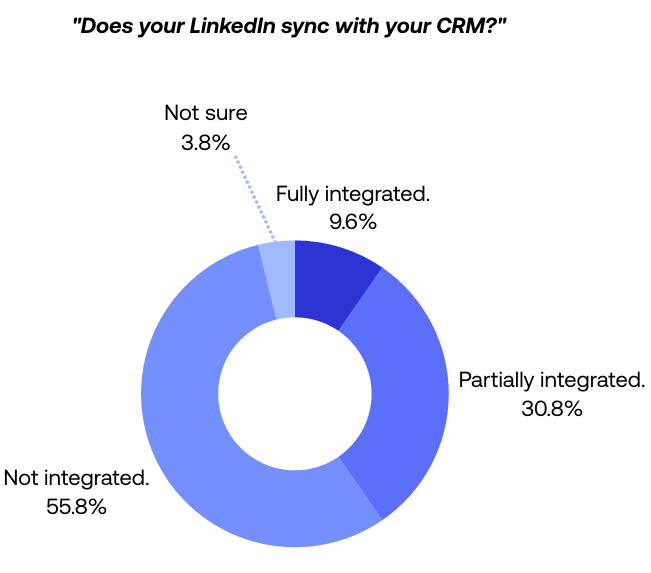
Our report found that 56% of sales teams still update their CRM manually or not at all. This “manual entry crisis” is causing valuable first-party data to be lost. High-growth organizations are solving this by automating the data flow from LinkedIn to their CRM on a scheduled basis.
The risk of manual entry isn’t just inefficiency—it’s data loss. When a rep leaves or forgets to log an interaction, that context disappears. Automated sync ensures every touchpoint is captured and becomes part of your owned dataset.
How to turn social data into owned data
Stop leaving your leads on LinkedIn. Ensure every interaction is captured in your CRM.
The strategy: Create a scheduled sync with alerts and periodic review between your LinkedIn activity and your CRM.
The workflow:
- Connect your HubSpot, Salesforce, or Pipedrive account to PhantomBuster.
- Use PhantomBuster’s HubSpot CRM Enricher automation (or the Salesforce/Pipedrive connector) as part of your CRM sync workflow.
- Set it to run daily or hourly, depending on your outreach volume.
- The automation syncs permitted public-profile fields (name, title, company, LinkedIn URL) and profile data you’ve collected with consent into your CRM. Don’t attempt to import private message history or email addresses directly from LinkedIn—use verified enrichment sources where you have a legal basis.
This builds your owned channels and protects you from platform volatility. If LinkedIn changes its policies or limits access, your data remains safe in your CRM.
4. How do you warm up prospects before sending a connection request?
Cold outreach and immediate pitches are seeing diminishing returns. The trend for 2026 is “social warming“—engaging with a prospect before you ever ask for a connection.
Our data suggests that authentic conversations start much more easily when the prospect already recognizes your name. Engagement rates on connection requests improve when recipients have seen a prior interaction from you—whether that’s a profile view, a like on their content, or a thoughtful comment.
This works because it mirrors natural behavior. In real networking, you don’t walk up to a stranger and pitch immediately. You show interest, find common ground, then start a conversation.
How to automate the “warm up”
You can’t manually engage with 50 prospects a day. But you can automate parts of the engagement sequence with conservative daily caps, randomized delays, and human oversight.
The strategy:
Touch the prospect 2-3 times before the connection request is sent.
The workflow:
- Use PhantomBuster’s LinkedIn Profile Visitor automation within a warm-up sequence, with conservative daily limits, to appear in their notifications.
- Follow this with the LinkedIn Auto Liker automation to like their most recent post.
- After a 24–48 hour delay, review the prospect list and send a personalized connection request using the LinkedIn Auto Connect automation with safe daily caps. Approve each message to ensure relevance.
This sequence signals genuine interest and often improves acceptance rates versus a cold request. The key is pacing—rushing the sequence defeats the purpose. Give each touchpoint time to register before moving to the next step.
Conclusion: The precision era of social selling
Success in 2026 belongs to sales teams that move from activity to accuracy. With AI, automation, and owned data at the core of your workflow, social selling becomes measurable, scalable, and authentic.
PhantomBuster helps you operationalize these workflows with pre-built automations and human-in-the-loop steps. Start a 14-day free trial to test these workflows on your accounts and measure the impact on replies and meetings.
Frequently asked questions about social selling trends
What are the biggest social selling trends for 2026?
The biggest shifts are the move from high-volume outreach to precision targeting, the use of AI for research rather than just content generation, and the importance of moving social data into owned channels (CRMs) to avoid data loss and maintain control over your pipeline.
Is social selling still effective in 2026?
Yes, but high-volume “spray and pray” is no longer reliable. Social selling in 2026 is about authentic conversations, timing, and intent signals. Using engagement cues—like seeing who viewed your profile or liked a post—is often the most effective starting point in B2B outreach.
How can AI tools help with social selling without sounding robotic?
The key is using AI for intelligence, not just generation. Use PhantomBuster’s AI automations to analyze public-profile fields and generate a unique hook based on the prospect’s actual activity. Keep a human approval step, respect platform limits, and never send a message without reviewing it first.
Why is CRM integration so important for social selling?
Our report found that 56% of sales teams fail to sync their LinkedIn data, leading to lost leads and wasted time. Automating this sync ensures you retain ownership of your first-party data and can nurture leads across multiple channels—email, phone, and retargeting—rather than relying solely on LinkedIn’s platform.