

A sleepless hero wearing every hat, from full-stack dev to HR head and customer support executive. That’s the image that comes to mind when most people think of a solo founder.
But the reality?
Manually handling the commercial aspect while building a product is a recipe for burnout, not business growth.
According to our The State of Sales on LinkedIn for 2026 report (December 2025), solo founders are increasingly automating their prospecting workflows. The most effective solo founders automate list-building and first-touch outreach, then spend their time on replies and demos.
This guide shows you how to skip the time-consuming manual work and use two proven workflows to find product-market fit and book your first revenue conversations without hiring a co-founder or a full sales team.
The “full stack” sales trap
Solo startup founders are often adept at technical aspects, such as developing ultra-small MVPs, navigating existing libraries, and reusing components to build fast.
Most solo founders are strong on build speed but time-poor on consistent prospecting and content. Instead of building for scale, they end up relying on manual one-on-one outreach.
A founder in Latin America described the struggle in our survey:
There is a lot of noise, many people and companies prospecting, how to stand out is the key element.
If you spend your days manually copying emails or writing marketing copy from scratch, you’re destined to struggle with business growth. A sustainable solo-founder strategy automates repetitive work—list-building and first touches—so you can focus on live conversations.
Automating marketing and sales functions with PhantomBuster
Solo founders can offload repetitive workSolo founders can offload repetitive work with PhantomBuster Automations—no agents or extra tools required.
In our 2026 State of Sales report (fielded November–December 2025), 80% of sales professionals report using some form of automation on LinkedIn. The largest group (43%) uses prospecting tools, while others use Chrome extensions and data enrichment add-ons.
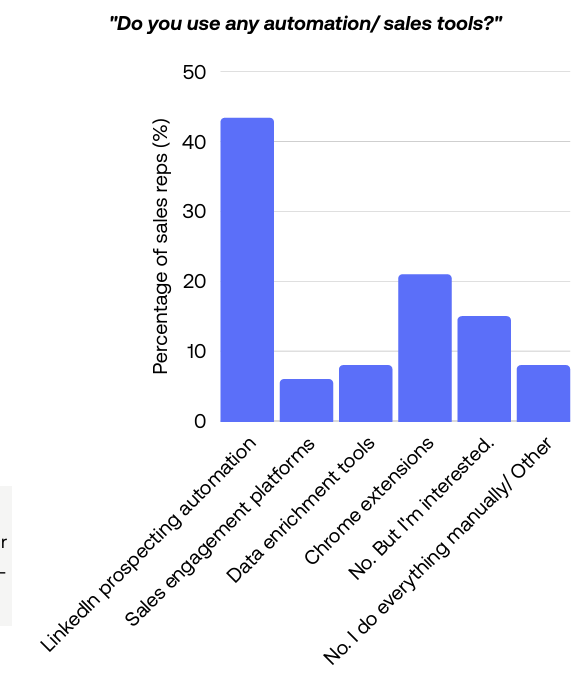
With PhantomBuster, you can automate most top-of-funnel tasks—finding profiles, enriching fields, and queuing first touches—so outreach continues when you’re heads-down on product. PhantomBuster combines profile discovery, enrichment, and scheduled messaging into one workflow, so you can run small product-market fit tests and measure replies by segment.
But automation doesn’t equate to spamming. It only works when combined with targeted, thoughtful messaging.
Nathan Guillaumin, a Product Expert at PhantomBuster, explains the mindset shift required:
You need to see automation as a time saver and not something magical. If you were not processing any actions on your LinkedIn account before and you are now using automations, you need to prepare your accounts to warm it up.
In the next sections, we’ll outline two concrete strategies to use PhantomBuster for revenue-generating work.
Strategy 1: Testing product-market fit (The MVP launch)
Before you invest in a Product Hunt launch or expensive paid ads, you need validation. For solo founders, LinkedIn works as a testing ground for early conversations.
Here’s how to structure the workflow:
1. Identify prospects who engage with related content
Use PhantomBuster’s LinkedIn Post Likers Export and LinkedIn Post Commenters Export Automations to extract a list of engaged potential customers into one spreadsheet view. Target posts that discuss problems your product solves.
This works because engagement signals interest. People who comment on posts about pricing tools, onboarding friction, or technical debt are actively thinking about those problems.
2. Engage with tailored messages
Draft first-touch notes with PhantomBuster’s AI LinkedIn Message Writer, then schedule connection requests and 1–2 follow-ups via LinkedIn Message Sender Automation—staying within LinkedIn’s daily limits and pausing on weekends.
Keep your volumes modest. Most founders see better results with 15–25 personalized touches per day than 50+ generic ones.
3. Learn from replies and iterate
If prospects accept and reply, you have validation. If they ignore you, test different messaging or adjust your target segment.
Run 3–5 message variants across two segments and compare reply rates after 72 hours. Keep the variant that clears 8–12% replies and iterate from there.
Strategy 2: Build a repeatable LinkedIn content workflow with PhantomBuster
Content creation is a major challenge for technical founders who lack copywriting and design skills. But you need a consistent presence for inbound lead generation.
Instead of hiring an agency, use PhantomBuster to track trending posts in your niche (by hashtag, creator list, or keyword) and capture comments for pain-point analysis. Follow these steps:
1. Extract audience pain points from trending conversations
Extract comments from relevant posts with PhantomBuster’s LinkedIn Post Commenters Export Automation. See what your target audience is talking about and identify their pain points.
Look for repeated frustrations, feature requests, or workarounds. These become your content topics.
2. Create content that resonates with real problems
Use these pain points to write marketing copy that resonates with your audience and publish compelling LinkedIn posts. Draft with PhantomBuster’s AI LinkedIn Message Writer, then edit for voice and specificity before publishing.
3. Distribute and engage thoughtfully
Identify commenters, then reply thoughtfully or DM with context. If appropriate, use PhantomBuster’s LinkedIn Auto Follow sparingly and skip auto-likes. Keep volumes low, personalize first lines, and respect LinkedIn’s limits.
With this workflow, you can create a story around your brand without hiring full-time marketers and reach customers who are already looking for your solution.
Comparison: Manual workflows vs. a founder using PhantomBuster
As a solo founder, here’s how your sales strategy changes when you bring automation into the mix.
| Task | The Manual Founder | Founder Using PhantomBuster |
|---|---|---|
| Lead Generation | Manual search on LinkedIn | Automated data extraction from LinkedIn and Sales Navigator |
| Outreach | 5–15 first touches/day (manual) | Within LinkedIn-safe ranges (typically 15–30/day)—prioritizing personalization over volume* |
| Copywriting | Writer’s block on marketing copy | AI-drafted personalized notes, edited for voice |
| Validation | Guessing product-market fit | Data-driven segmented testing with measurable reply rates |
| Time Cost | ~10–20 hrs/week (manual prospecting + first touches) | ~3–6 hrs/week (setup + reply handling), based on a 200-contact test* |
*Ranges based on typical solo-founder workflows observed in our 2026 State of Sales research.
Build fast, sell faster with PhantomBuster
If you’re a full-stack developer, you wouldn’t write your own database from scratch. You’d use existing libraries.
As a solo founder, you need to treat sales the same way.
PhantomBuster bundles prospect discovery, enrichmentPhantomBuster bundles prospect discovery, enrichment, and scheduled messaging, so you can validate ideas and book early conversations without hiring. Create a LinkedIn search → export profiles → enrich missing fields → queue first touches → track replies in one sheet—all inside PhantomBuster.
FAQs
What is the best solo founder sales strategy?
Effective solo-founder strategies automate list-building and first touches, then reserve your time for replies and demos. With PhantomBuster, you can find profiles, enrich data, and queue messages—so you maintain a steady pipeline while coding. This approach helps you maintain a consistent flow of prospects while focusing on product development and finding product-market fit.
How can a technical founder improve marketing skills?
Use PhantomBuster’s AI LinkedIn Message Writer to draft first-touch notes and post captions, then edit for voice and specificity before publishing.
Track trending posts in your niche and comments on these posts to uncover real pain points. Next, turn those insights into high-impact, personalized content.
How do I get my first sales as a solo founder?
Focus on direct outreach rather than passive brand building. Use PhantomBuster to identify potential customers on LinkedIn who match your specific tech stack or problem set.
Then, send them personalized messages to solicit feedback or offer a demo. Direct conversations are often the fastest path to first revenue for early-stage products.
Is PhantomBuster useful for service businesses?
Yes. For both SaaS and services, early pipeline depends on consistently meeting qualified buyers. PhantomBuster helps you run compliant, targeted first touches and follow-ups to start those conversations. It is particularly effective for high-ticket services where building relationships is key.
How much time should a solo founder spend on sales?
Without automation, sales can become a full-time job. With automation, many founders reduce prospecting time substantially and reallocate more hours to product and live conversations. Track it: compare weekly hours before and after a two-week pilot to measure your own gains.
Can I launch on Product Hunt and use LinkedIn?
Yes. A Product Hunt launch gives you a spike in traffic, but LinkedIn provides sustainable growth. Where profiles are publicly shared, use PhantomBuster to collect them. Respect each platform’s terms and daily limits, and send context-rich invitations rather than generic links to your landing page.
What if I feel bad about using automation?
Many founders equate automation with spam. However, if you use a tool like PhantomBuster to send relevant, targeted messages to people who actually need your solution, you are providing value, not spam.
PhantomBuster supports schedules and configurable delays to avoid bursty activity. Always prioritize relevance and personalization, and follow each platform’s rules and safe ranges.
How do I find product-market fit with automation?
Finding product-market fit requires data. Automate outreach to different segments (e.g., “Designers” vs. “Developers”) to measure which group gives positive feedback. If one group ignores you and the other replies, you have found your point of entry. This segmented testing is faster and more systematic than manual outreach.
Start your 14-day free trial and see how you can use PhantomBuster to automate list-building and first touches while you focus on product development and live conversations.