
When we analyzed the data for our report, The State of Sales on LinkedIn in 2026 (December 2025), a clear pattern emerged. Success isn’t random in LinkedIn sales. It is a function of two specific variables: volume (how many requests you send) and acceptance rate (how many people say yes).
Our Q4 2025 survey of founders, SDRs, team leads, and AEs shows LinkedIn results come down to these two variables—and what drives both.
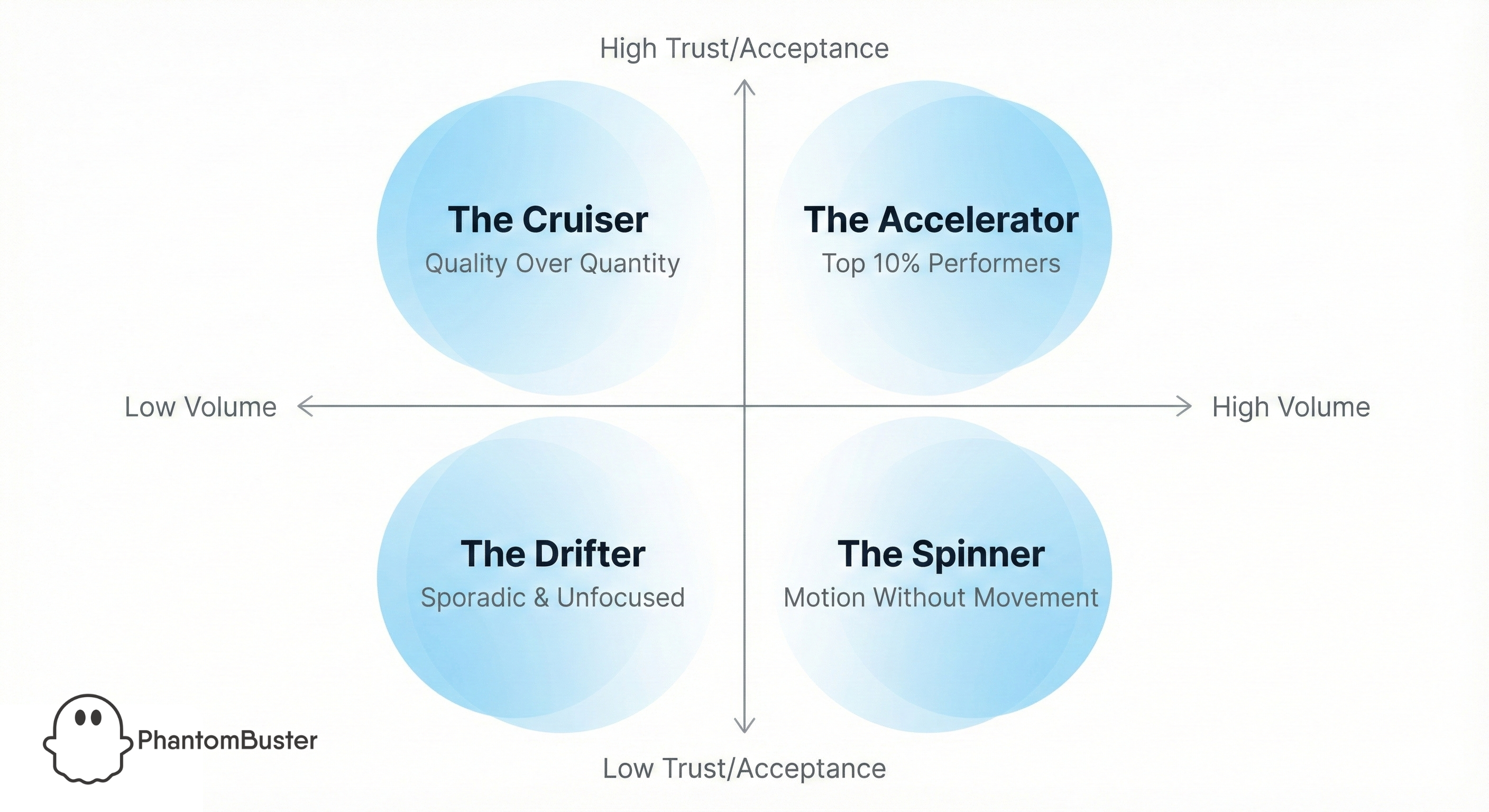
By plotting request volume, acceptance rate, hours spent, and workflow type, we identified four distinct prospecting archetypes: The Accelerator, The Spinner, The Cruiser, and The Drifter.
Understanding which category you currently fall into is the first step to fixing your sales strategy. This guide breaks down each archetype and gives you PhantomBuster playbooks to reach Accelerator status.
Read the full report: The State of Sales on LinkedIn in 2026 (December 2025)
Key Findings
Based on PhantomBuster’s Q4 2025 survey of B2B sales professionals:
- Four archetypes define LinkedIn prospecting performance: Spinners (high volume, 25% acceptance), Cruisers (low volume, 56% acceptance), Drifters (low volume, 35% acceptance), and Accelerators (high volume, 45% acceptance).
- Accelerators achieve 11× the efficiency of Cruisers: Both invest similar weekly hours, but Accelerators generate 6 accepted connections per hour compared to Cruisers’ 0.53.
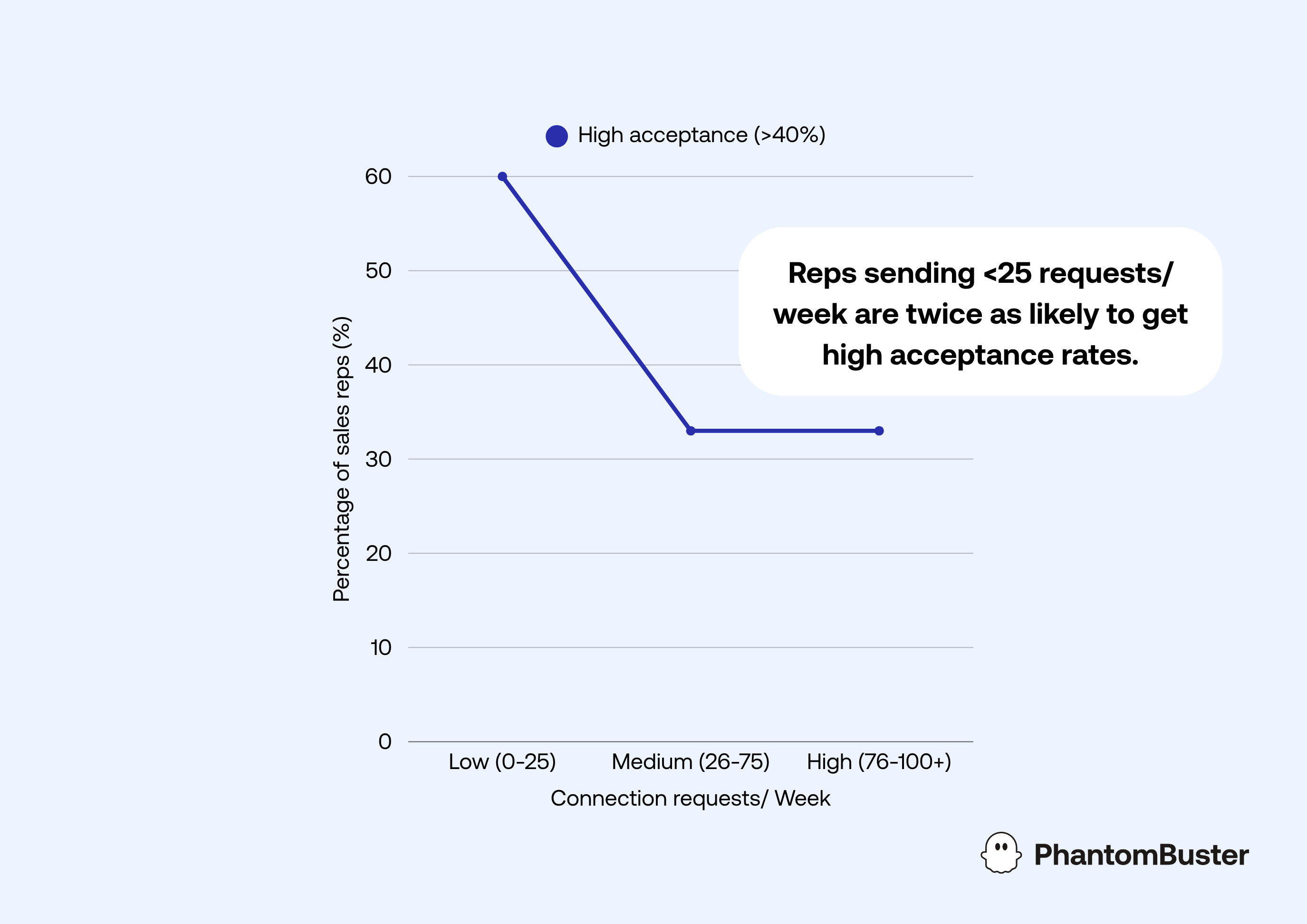
- Spinners and Accelerators send similar volume (76–100+ requests/week), but Accelerators convert at nearly double the rate: 45% acceptance vs. 25%, proving targeting and warming matter more than raw volume.
- Cruisers have the highest acceptance rate (56%) but the lowest scalability: Their manual research process caps output at fewer than 3 connections per week, leaving pipeline growth on the table.
- Drifters have the lowest efficiency across all metrics: At 0.43 accepted requests per hour and 35% acceptance, they invest time without a strategy or measurable results.
Acceptance rate, not raw volume, separates Accelerators from Spinners.
Archetype 1: The Spinner (High Volume, Low Trust)
Who they are
Spinners equate more messages with more deals. They often send 500+ messages in a week—but results stall.
The Spinner believes sales are purely a numbers game. They prioritize volume over targeting or warming, which keeps acceptance rates around ~25%.
But here’s the thing about spinning: you can generate all the velocity in the world and still achieve zero displacement. That’s the Spinner’s paradox. Despite this high volume, their acceptance rate hovers around 25%.
The Data
- Behavior: High connection requests (76–100+).
- Acceptance Rate: Low (~25%).
- Efficiency: 3.33 accepted requests per hour.
The Problem
To put the data in context: they’re working just as hard as top performers who invest around 7.5 hours per week on LinkedIn—but they are converting at half the rate. For every four hours invested, two are spent absorbing rejection.
At 3.33 accepted requests/hour, half of the same time invested by Accelerators produces fewer accepted connections.
Here’s what happens when you prioritize volume over relevance.
Your messaging becomes generic because personalization doesn’t scale when you send 100+ requests per week without preparation. Your acceptance rate drops because prospects can spot a mass blast from a mile away. And you contribute to the exact problem that makes LinkedIn harder for everyone: noise.
As one founder in Latin America put it in our Q4 2025 survey:
There is a lot of noise, many people and companies prospecting, how to stand out is the key element.
The PhantomBuster Fix
The solution isn’t to send fewer requests. It’s to change what happens before the request, and this is where social warming comes in. Instead of cold outreach, you first create ambient familiarity. Visit a prospect’s profile, like their recent post. Leave a thoughtful comment, and by the time your connection request arrives, you won’t be a stranger anymore. You’re someone who already showed interest in their work.
PhantomBuster automates this sequence without requiring you to visit 100 profiles manually each week. Run profile views and post likes within LinkedIn’s daily and weekly limits. Set caps in PhantomBuster so warming stays safe and consistent. You focus on the conversations that actually start.
Stay within LinkedIn limits: Set daily caps in PhantomBuster (e.g., 20–40 connection requests per day depending on account age and history). Start conservatively and ramp gradually as your acceptance rate improves.
As Nathan Guillaumin, PhantomBuster Product Expert, explains:
All the clients who have implemented social warming techniques saw an increase in their acceptance and reply rates. Your leads will see your name and profile before you send the connection.
Archetype 2: The Cruiser (Low Volume, High Trust)
Who they are
The Cruiser knows the waters. They don’t rush into hasty decisions. They sail through LinkedIn with the calm confidence of someone who understands that building trust through relationships is the real currency.
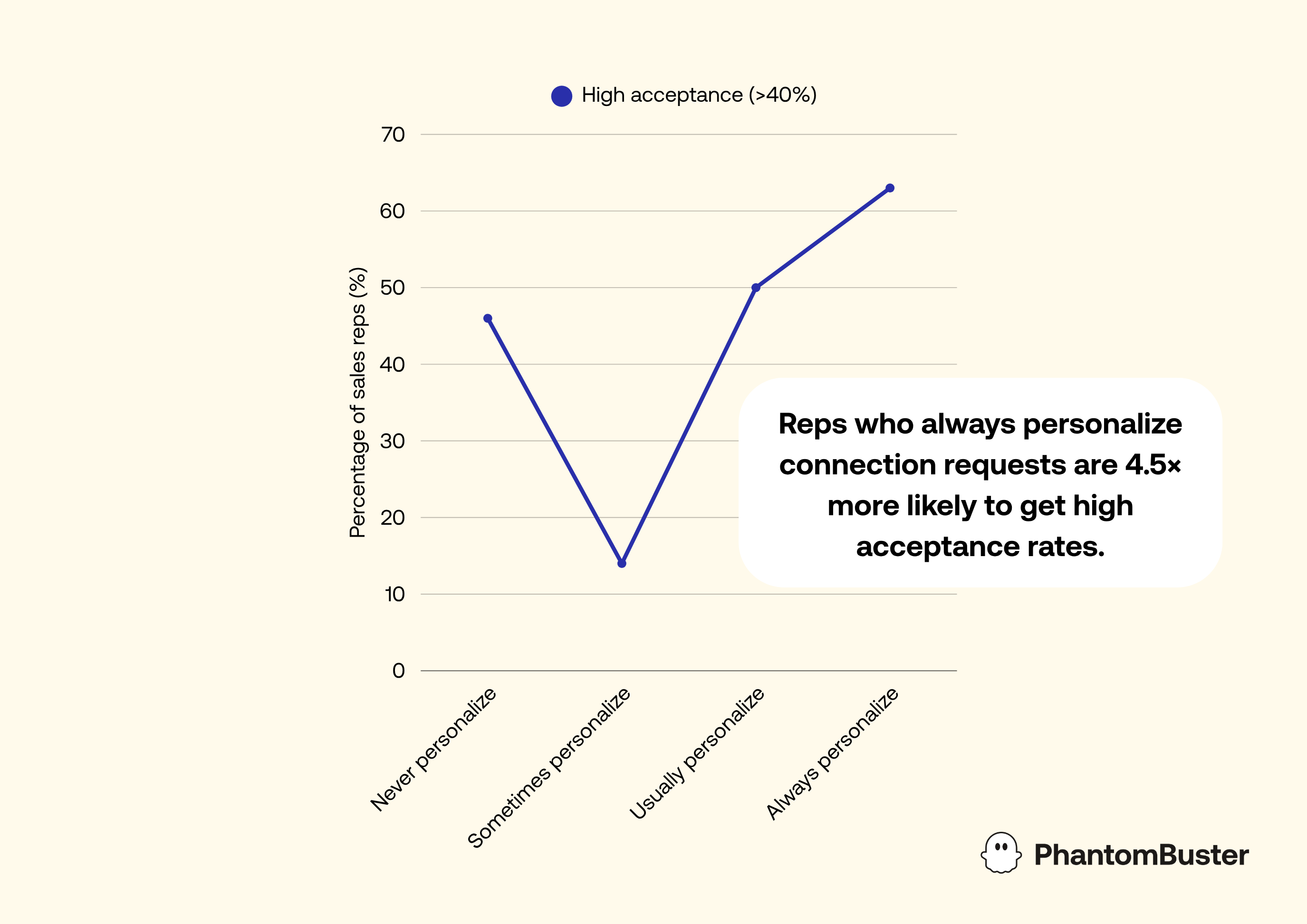
Cruisers take their time. They research every prospect thoroughly. They craft personalized messages that reference specifics from the prospect’s profile or posts. They build genuine relationships before making any ask, and their acceptance rate proves the approach works.
The Data
- Behavior: Low connection requests (0–25).
- Acceptance Rate: High (~56%).
- Efficiency: 0.53 accepted requests per hour.
That acceptance rate looks impressive. More than half of the people they reach out to say yes. But look at what it costs to get there.
At 5.2 hours/week and 0.53 accepted/hour, Cruisers land ~2–3 accepted connections per week.
The Problem
When you receive a Cruiser’s sales message, you know they’ve done the work because their outreach references specifics from the prospect’s profile or posts, and their outreach feels personal.
The issue is capacity. If you spend 30 minutes researching a single prospect before reaching out, you cap yourself at roughly 10–15 quality touchpoints per week. That’s the math. There are only so many hours available, and deep research takes time.
Most Cruisers resist automation because they believe it will compromise quality. They’ve seen generic outreach, and they’ve watched Spinners blast the platform with copy-paste messages. They don’t want to be that.
The PhantomBuster Fix
The solution for Cruisers isn’t to abandon their approach. It’s to automate the mechanical parts so they can scale the human parts. That means you can maintain the same level of personalization while reaching materially higher volume without losing personalization—with human review required before each send.
That is where PhantomBuster comes in. The LinkedIn Profile Export automation lets Cruisers extract data on job history, recent posts, and shared connections for 50 prospects at once. You review the context, write personalized notes informed by that data, and send strategic messages—without spending 30 minutes manually researching each profile.
Archetype 3: The Drifter (Low Volume, Low Trust)
Who they are
Drifters log into LinkedIn sporadically. They send a few connection requests when they remember. They scroll through the feed without engaging. In simple terms, they’re on the platform but not really using it to its full potential.
The data shows exactly what that produces.
The Data
- Behavior: Low connection requests (0–25).
- Acceptance Rate: Low (~35%).
- Efficiency: 0.43 accepted requests per hour.
The Problem
That’s the lowest efficiency among all archetypes in our study. Four hours per week on LinkedIn. Fewer than 2 accepted connections to show for it. Less than half a connection per hour.
Put differently: a Drifter can invest an entire month on LinkedIn and end up with fewer meaningful relationships than an Accelerator builds in a single afternoon.
Low structure means low win-rate even when time is invested.
The problem isn’t effort; they are spending time on the platform. The problem is that the time doesn’t follow any coherent strategy—just sporadic activity that leads nowhere.
The PhantomBuster Fix
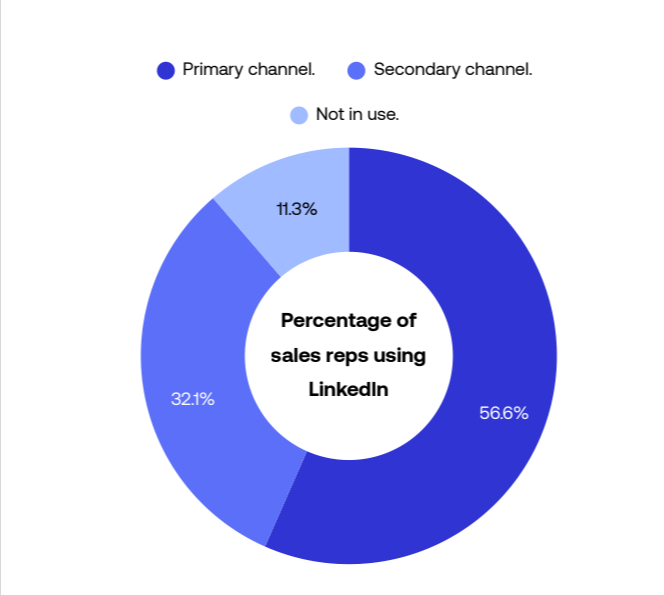
LinkedIn used to reward passive presence. You could set up a solid profile, accept inbound requests, and wait for opportunities to find you. According to our December 2025 report, that era is over—nearly 9 in 10 B2B sellers actively prospect on LinkedIn.
Drifters need a “Wake Up” campaign. The fastest way for Drifters to build momentum is to target warm leads who are already engaging with competitors.
Add the LinkedIn Post Commenters Export automation to your warming workflow in PhantomBuster, then filter commenters by role and seniority before outreach. Point it at a competitor’s recent post, and it extracts a list of everyone who commented. These aren’t random names. They’re prospects who actively care about the problem your product solves.
Now you have a qualified list. You know they’re interested. You know they’re active on LinkedIn. And you have context for your outreach: you can reference the post they commented on.
From there, build a simple sequence:
Day 1: Visit their profile.
Day 3: Like one of their recent posts.
Day 5: Send a personalized connection request referencing the conversation they were part of.
Day 10: Follow up with a message that offers value related to that topic.
Archetype 4: The Accelerator (High Volume, High Trust)
Who they are
Accelerators represent ~10% of our dataset.
While Spinners burn through their weekly limits and Cruisers labor over every message, Accelerators move through LinkedIn with a different rhythm entirely. They send as many requests as the highest-volume prospectors. They convert at ~45% acceptance—near Cruiser-level trust but at higher volume. And they do it without working longer hours or sacrificing quality.
They combine intent-based targeting with warming and personalized outreach, so volume and acceptance rise together.
This cohort sets the performance benchmark in our dataset.
The Data
- Behavior: High connection requests (76–100+).
- Acceptance Rate: High (~45%).
- Efficiency: 6 accepted requests per hour.
The Advantage
That last number is the one that matters most. Six accepted connections per hour means that, in the same time a Cruiser builds half a relationship, an Accelerator builds six. While a Spinner wastes effort on rejection, an Accelerator is already three conversations deep into follow-up.
The efficiency gap isn’t small. Accelerators are 11× more efficient than Cruisers. They’re nearly 2× more efficient than Spinners, despite sending the same volume. They run an integrated PhantomBuster workflow: extract target lists, warm with profile visits and likes, generate personalized drafts, then sync results to the CRM—so most time goes to live conversations.
Comparison: The Efficiency Gap
The table below highlights why moving to the “Accelerator” archetype is critical for pipeline growth.
| Archetype | Behavior | Median request volume | Median acceptance rate | Median hours/ week | Efficiency (Accepted requests/ hour) |
|---|---|---|---|---|---|
| Accelerator | High connection requests (76–100+) High acceptance (>40%) | 100 | 45% | 7.5 | 6 |
| Spinner | High connection requests (76–100+) Low acceptance (<40%) | 100 | 25% | 7.5 | 3.33 |
| Cruiser | Low connection requests (0–25) High acceptance (>40%) | 5 | 56% | 5.2 | 0.53 |
| Drifter | Low connection requests (0–25) Low acceptance (<40%) | 5 | 35% | 4 | 0.43 |
How to Become an Accelerator with PhantomBuster
To move up, standardize a data-backed direct-selling workflow and automate the repetitive steps—while keeping message review and targeting decisions human.
Here’s how to make the transition.
1. Automate the research (for the Spinner)
In PhantomBuster, add the Sales Navigator Search Export automation, then filter for buying signals: recent funding, active hiring, or job changes within the last 90 days. Export results to your “Warm Prospects” list for the next step. This ensures your high-volume efforts are directed at qualified leads, not random prospects.
The Spinner problem: Blasting 100 requests per week at anyone with the right job title. No buying signals. No context. Just volume for volume’s sake.
The fix: Target with intent. Filter for companies that recently raised funding. Teams are hiring for roles that signal growth. Prospects who changed jobs in the last 90 days. People engaging with competitor content.
When your list is built on buying signals instead of job titles alone, your acceptance rate climbs immediately. You’re reaching people at the right moment, not interrupting them at random.
2. Automate the “human touch” (for the Cruiser)
Add the AI Message Writer automation to draft personalized notes from profile and post context; you approve or edit each message before sending. The AI references specific details from the prospect’s profile, recent posts, and activity.
Cruiser problem: Spending 20–30 minutes per prospect to establish one-on-one context limits scale. Writing every message from scratch. High quality but impossible to scale.
The fix: Let AI handle the research layer. PhantomBuster’s AI Message Writer pulls context from profiles, recent posts, company news, and shared connections. It drafts personalized messages that reference specifics, so every outreach feels custom even though the prep took 30 seconds instead of 30 minutes.
You still make the strategic decisions—what angle to take, what value to offer, how to position the ask. The AI handles the data gathering that used to eat up your time.
3. Sync to CRM
Accelerators don’t do data entry. An Account Executive in Europe required automatic Salesforce syncing without internal engineering support.
Enable the CRM Sync automation in PhantomBuster so new connections and replies log automatically to Salesforce, HubSpot, or Pipedrive.
Automate the sync. Connect PhantomBuster to Salesforce, HubSpot, Pipedrive, or your CRM of choice. Set up sync rules once. Let the system run in the background while you focus on conversations that actually convert.
Conclusion: What top performers do differently
Your prospecting archetype determines your revenue trajectory. If you are a Cruiser, you are leaving money on the table due to lack of scale. If you are a Spinner, you are burning your brand’s credibility.
The teams winning on LinkedIn in 2026 aren’t choosing between personalization and scale. They’re using automation to achieve both. They’re targeting with buying signals, warming systematically, personalizing with AI-assisted research, and syncing seamlessly to CRM. They removed manual steps that slow teams down, which frees more time for live conversations.
The data from our December 2025 survey is clear: Teams reach Accelerator-level results faster when they automate the repetitive steps with PhantomBuster while keeping targeting and message review human.
Ready to shift archetypes? Build your Accelerator workflow in PhantomBuster: targeting with buying signals → warming with profile visits and post engagement → AI-assisted personalized drafts → CRM sync. Set safe daily caps (start with 20–40 warmed requests per day depending on account age). Review every draft before sending. Track acceptance rates weekly and adjust targeting based on what converts.
FAQ: B2B Prospecting Archetypes
What is the best prospecting archetype?
The Accelerator is the most effective archetype. According to our data, Accelerators achieve an efficiency score of 6 accepted requests per hour, compared to just 0.53 for Cruisers. They maintain high trust (45% acceptance) while keeping volume high, typically by running an integrated PhantomBuster workflow (targeting → warming → personalized drafts → CRM sync). This raises accepted connections and reply rates while keeping CRM data current for both SDRs and AEs.
Why do “Spinners” have low acceptance rates?
Spinners suffer from “Spray and Pray” syndrome. They send at max volume (100+ requests) but use generic outreach without personalization or warming. This results in a ~25% acceptance rate. To fix this, Spinners should use PhantomBuster’s social warming automations (Profile Visit + Post Liker) before sending a request, transforming cold leads into warm leads through strategic sequencing.
Can a “Cruiser” scale without losing quality?
Yes. Cruisers average ~2–3 accepted connections/week at 0.53 accepted/hour. With AI-assisted drafting and warming, they can raise weekly accepted connections materially while keeping messages specific to each prospect. The key is automating data extraction and draft generation while keeping final message approval manual.
How do I stop being a Drifter?
Drifters often lack a routine. Set a daily social-warming automation in PhantomBuster (e.g., Post Liker). Cap actions per day to stay within LinkedIn limits. This builds a LinkedIn presence with minimal effort, gradually moving you toward the active engagement of an Accelerator. A consistent outbound routine increases profile views and engagement, which in turn raises inbound interest (views, invites, replies).
Does the “direct sales approach” still work?
Yes—when you time direct outreach with buying signals, warm first, and personalize the ask. Direct selling strategies (outbound connection requests) are the primary driver of growth for top performers. However, the data shows that direct contact must be relevant and timed correctly (using warming) to avoid the low acceptance rates seen in the “Spinner” group. Understanding when to employ direct selling strategies versus indirect selling strategies is crucial.
What is the “Efficiency Score” in the report?
Efficiency is calculated by the number of accepted connection requests generated per hour of work. Accelerators generate 6 new connections per hour, while manual prospecting (Cruisers) generates only 0.53. This metric shows why shifting admin work to automation frees more time for live conversations and follow-ups.
How do these archetypes relate to traditional sales methodology?
These archetypes map to the two major selling styles: direct and indirect. Spinners and Accelerators employ high-volume direct selling tactics, while Cruisers lean toward an indirect sales approach that focuses on building relationships before asking for commitments. Drifters struggle because they haven’t committed to either style consistently.