

When you assess a sales tool, the question isn’t the monthly fee—it’s whether it saves you 10+ hours a week and adds meetings to your pipeline.
According to our The State of Sales on LinkedIn for 2026 report, 40% of sales reps still update their CRM manually. If a rep spends 30 minutes per day on CRM updates, checking titles, and verifying emails, that’s 2.5 hours per week. Add prospecting and data export tasks, and teams often report 6–12 hours of repetitive work that could be automated, impacting sales efficiency. Add prospecting and data export tasks, and teams often report 6–12 hours of repetitive work that could be automated.
If you view PhantomBuster as a line-item expense, it might seem like another subscription. But if you view it through the lens of sales pipeline efficiency, the math shifts. Here’s the ROI formula:
Monthly ROI = (hours saved × fully loaded hourly rate) – plan cost
This guide breaks down the hidden costs of manual prospecting and static databases, then shows you how to calculate your baseline and validate whether automation offsets its cost.
The high cost of “static” data
Many sales teams try to save money by buying large, static lead lists from database providers. On the surface, this looks cheaper than generating your own fresh data.
However, contact data decays at 20–30% annually due to job changes and company turnover. On a 10,000-record list, 2,000–3,000 contacts may be stale within 12 months—especially in high-turnover industries.
- The cost: You pay for outdated data.
- The damage: High bounce rates, damaged domain reputation, and wasted outreach efforts.
PhantomBuster Automations pull up-to-date data at run time from pages you can access, so lists stay current when you export. Use the Sales Navigator Search Export and the LinkedIn Profile Scraper automation to extract currently visible profile data you’re allowed to view. You export what’s visible at run time—titles, company, recent activity. Always verify emails before outreach and respect LinkedIn limits and terms.
As Nathan Guillaumin, Product Expert at PhantomBuster, puts it: automation saves time, not magic. If you’re new to LinkedIn actions, warm up each account gradually before scaling.
What to do next:
- Audit your current lead lists: revalidate 10% of records and compare bounce rates before and after automation.
- Track how many contacts in your CRM have outdated job titles or company names.
- Measure the time saved when you export fresh data instead of purchasing static lists.
The labor calculation: Salary vs. subscription
A typical SDR or Account Executive costs more than base salary. Here’s the math:
Example: $80k base salary + 25% benefits and overhead ≈ $100k/year → ~$48/hour
If that rep spends 10 hours a week on tasks that could be automatedIf that rep spends 10 hours a week on tasks that could be automated—finding profiles, sending connection requests, extracting data, and updating the CRM—that’s $480 per week, or roughly $1,920 per month in labor cost.
Most teams break even if they save 2–4 hours per rep per month. Verify your breakeven point against the current pricing page.
With PhantomBuster Automations handling data collection and message prep, reps spend more time in conversations. This helps small teams match larger teams’ prospecting throughput per rep, without adding headcount.
What to do next:
- Calculate your team’s fully loaded hourly rate (salary + benefits + overhead ÷ working hours).
- Track how many hours per week each rep spends on manual prospecting and data entry.
- Multiply hours saved by the hourly rate to determine your ROI threshold.
Precision targeting: Quality is cheaper than volume
Is PhantomBuster expensive? Not if it prevents you from burning through your Total Addressable Market (TAM).
Cheap tools encourage “Spray and Pray.” They let you blast generic messages to thousands. Precision wins because signals (commented on X, follows Y) improve targeting and reply rates without burning your TAM.
1. Identify engaged prospects
Use the LinkedIn Post Commenters Export to find 100 people genuinely interested in a topic relevant to your offer.
2. Draft personalized messages
Use the AI LinkedIn Message Writer to draft messages referencing that topic or comment.
3. Send and measure reply rate
Example: If you get ~10–20% replies on a targeted list of 100 vs. ~1% on a broad list of 1,000, the targeted path preserves your TAM and drives more meetings per send.
By focusing on targeted leads and personalized connection requests, you lower your Customer Acquisition Cost (CAC).
What to do next:
- Run a test: send personalized outreach to 50 targeted prospects and compare reply rates to your current baseline.
- Track how many prospects move to meetings vs. cold replies.
- Calculate cost-per-meeting for targeted outreach vs. volume outreach.
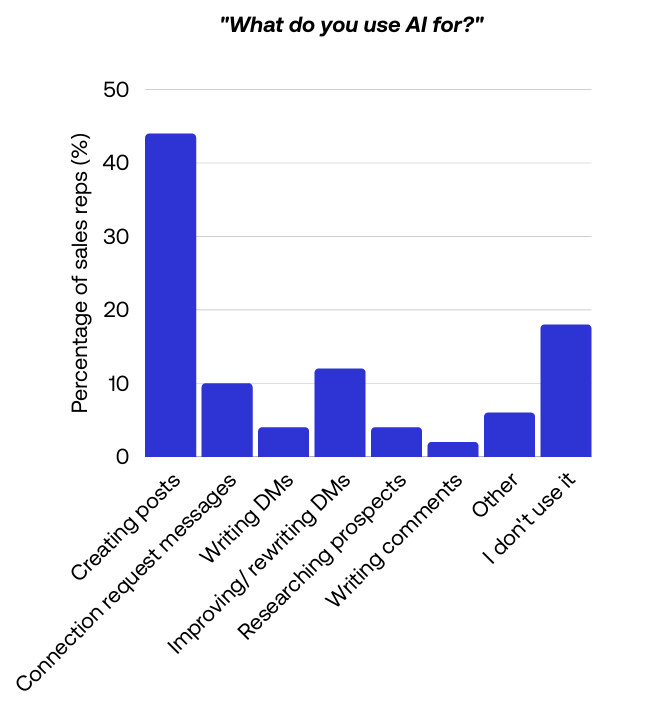
Comparison: The economics of prospecting
Here’s how common prospecting methods compare on cost, data freshness, and risk.
| Method | Cost basis | Data quality | Account safety | ROI |
|---|---|---|---|---|
| Manual prospecting | High (~$48–55/hr labor) | Quality varies with rep skill and time available | Highest—but throughput is low | Low (cannot scale) |
| Static database | Medium (per record) | Decays 20–30% annually without revalidation | Depends on sending practices and warmup | Medium (high waste) |
| Browser extension | Low upfront cost | Medium—depends on source freshness | Extensions manipulate your live session; misconfigured rates raise risk | Low (risk heavy) |
| PhantomBuster | Flat monthly fee | Up-to-date at run time; verify emails before sending | Cloud execution removes live browser session. Safety depends on conservative scheduling and respecting platform limits. | High when used responsibly |
Beyond LinkedIn: Multi-channel ROI
PhantomBuster Automations aren’t limited to LinkedIn prospecting. You can run multi-channel workflows to increase ROI.
Use Google Maps Search Export to list local businesses with publicly available details (e.g., website, phone). Validate consent and comply with local outreach rules before contacting.
Where platforms allow it, combine publicly visible audience data with first-party CRM data to enrich targeting. Always respect platform terms and privacy regulations.
Consolidating exports, enrichment, and CRM sync in one place reduces tool switching and admin time—typically a few hours per month per rep.
What to do next:
- Identify which channels your target accounts are active on (LinkedIn, Twitter, industry forums).
- Build a multi-channel workflow: LinkedIn connection → email follow-up → Twitter engagement.
- Track reply rates and meetings booked by channel to prioritize your efforts.
Conclusion: An investment in velocity
So, is PhantomBuster expensive? If you compare it to a $10 browser plugin that might get your account restricted, perhaps.
But compared to manual work, teams usually break even when Automations replace a few hours of repetitive tasks per rep each month.
It frees reps to spend more time in conversations and pipeline management instead of copy-paste work.
Prove it in 3 steps:
- Run a Sales Navigator search export and enrich 50 contacts.
- Push the enriched data to your CRM and launch a personalized outreach sequence.
- Measure reply rate and meetings booked, then compare to your current baseline.
Start today with your free 14-day trial for PhantomBuster.
FAQ: PhantomBuster pricing & value
Is PhantomBuster worth it?
For teams spending 2+ hours per week on manual prospecting, PhantomBuster often offsets its cost. Validate with your baseline using the ROI calculator above.
Automating repetitive tasks—data extraction, email discovery, and CRM updates—allows sales teams to focus on revenue-generating activities like meetings and closing.
How much does PhantomBuster cost?
PhantomBuster pricing scales by execution time and automation slots. We offer a free plan with limited execution time to test the platform. See current tiers on the pricing page.
Does PhantomBuster include email credits?
Some plans include monthly email discovery credits—check the pricing page for current allocations. This allows you to find professional email addresses for the profiles you extract without needing a separate data enrichment subscription.
Is it cheaper than buying lead lists?
In many cases, yes. Lead list vendors charge $0.50–$1.00 per contact (or more for niche industries), and that data decays over time. PhantomBuster operates on a flat monthly fee.
Because you export current data at run time, your lists start fresher. Verify emails before sending and follow warmup best practices to protect sender reputation.
Can I try it for free?
Yes. PhantomBuster offers a 14-day free trial. You can use this time to run your first LinkedIn search export, test CRM integration, and see the quality of the extracted data before committing to a subscription.
Most users ship a first export in under an hour—follow the 3-step quick start above to validate fit.
Does a PhantomBuster account replace a Sales Navigator subscription?
No, it complements it. To get the most out of PhantomBuster for LinkedIn workflows, we recommend having LinkedIn Sales Navigator. Sales Navigator enables advanced filters and higher export volumes. Exact limits change—check LinkedIn’s current policies and respect their terms.
How does it compare to browser extensions?
PhantomBuster runs in the cloud, so you don’t need a live browser session. Schedule conservative rates and follow platform limits to reduce risk.
This also means campaigns can run on schedules even when your computer is off.
What happens if I have multiple team members?
Our Team plan adds seats, shared resources, and workspace-level controls so managers can oversee campaigns across teammates. This is ideal for agencies or larger sales teams where a manager wants to ensure consistent data collection and monitor campaign performance across the department.